But it was conscience, really. We had to become small again to stay honest.
In the villages of Madhya Pradesh, comparison can feel like inheritance. Some families leave, some stay; some have toilets, others fetch water from the well. A child learns early what people mean when they ask, "Will he make something of himself?"
Sandeep Mehto remembers those questions more than the answers. He grew up in Kesla in a joint family. His father had eight siblings, some of whom left home in search of urban pastures. The home he grew up in fed travelling relatives and silently carried their judgment at the lack of urban amenities. "I have always been a sensitive guy and it felt like an unfair comparison," he says. That quiet accounting of worth would one day shape everything he built.

the question of enough
At five, he joined the new English-medium school started by Power Grid Corporation in India. Later, his father made a decision that changed the arc of his life: to send him to a boarding school in Bhopal. "We didn't have the money," Sandeep says. "But he still spent forty thousand rupees. That was courage." When the family business collapsed, the fees stopped. He studied for his board exams from home, barely passed, and carried the kind of self-doubt that clings quietly to bright children who are told they have failed.
He took mathematics because that was what "smart" students did. He tried for engineering, lost a year, did everything he could to to re-enter college, and topped his class. "There was freedom in anonymity," he says. "In higher education, nobody knew my story. That made me strong."
Then came the loss that re-centred him: on Diwali, during his final year, his father died of a heart attack. The house was filled with mourners speaking of the man Sandeep had often judged harshly. "I realised that what my relatives called his weakness — helping others before himself — was the same thing I admired in my teachers later. That realisation stayed."
learning the language of privilege
After engineering, Sandeep prepared for entrance exams and discovered the Tata Institute of Social Sciences. He applied for three programmes and was accepted into Social Entrepreneurship — the course that changed how he saw both opportunity and inequality.
In TISS classrooms, he studied ideas that gave names to things he had lived without naming: financial, social, and cultural capital. "I understood why I could reach higher education when others couldn't," he says. "My family wasn't rich, but we valued education. That was social capital."
He began to see privilege differently — not as guilt but as awareness. "Every person is privileged in some way," he says. "For me, it was education and the ability to tell my story. Acknowledging that itself became privilege."
That realisation would form the heart of Bharat Calling, the initiative he founded to help rural students access higher education — not through charity but through consciousness. "I could have channelled my frustration by chasing success abroad," he says. "Instead, I found another way to use that energy."
the first call
The idea began as a small pilot with 20 students. "We were just twenty-two, twenty-three," he laughs. "But 20 of them got into good colleges. That gave us the courage to continue."
The early years were a blur of hope and improvisation. Sandeep and his friends guided students through entrance forms, fee payments, and long train journeys to distant colleges. They discovered that most barriers weren't academic — they were emotional. "Many students had never even entered a college campus. It looked too big, too alien."
He remembers one girl who cooked at weddings to support her family. She joined a music programme, became a teacher, and now works in Visakhapatnam. "Every child is good at something," he says. "Our job is to notice it before the world tells them otherwise."
What began as informal mentoring became a model: assessment tests, home visits, career report cards, and follow-up support. Bharat Calling helped hundreds of students cross thresholds that once looked impossible. More than 450 graduated from top colleges across India and are now in the workforce. But for Sandeep, the real work was quieter — convincing families, not funding fees. "Money is easy to find," he says. "Conviction is hard."
the privilege to listen
Sandeep calls his approach "soft-side work". He resists the language of targets and impact graphs. "If you approach a child with purity," he says, "they give you a part of their life."
During one school visit, a teacher watched students write their hearts out on assessment forms. "They had never spoken so openly before," she told him. For Sandeep, that trust is the success metric. "We never do one-time awareness sessions. If you start something, you stay until they're ready. Otherwise, it feels like a crime."
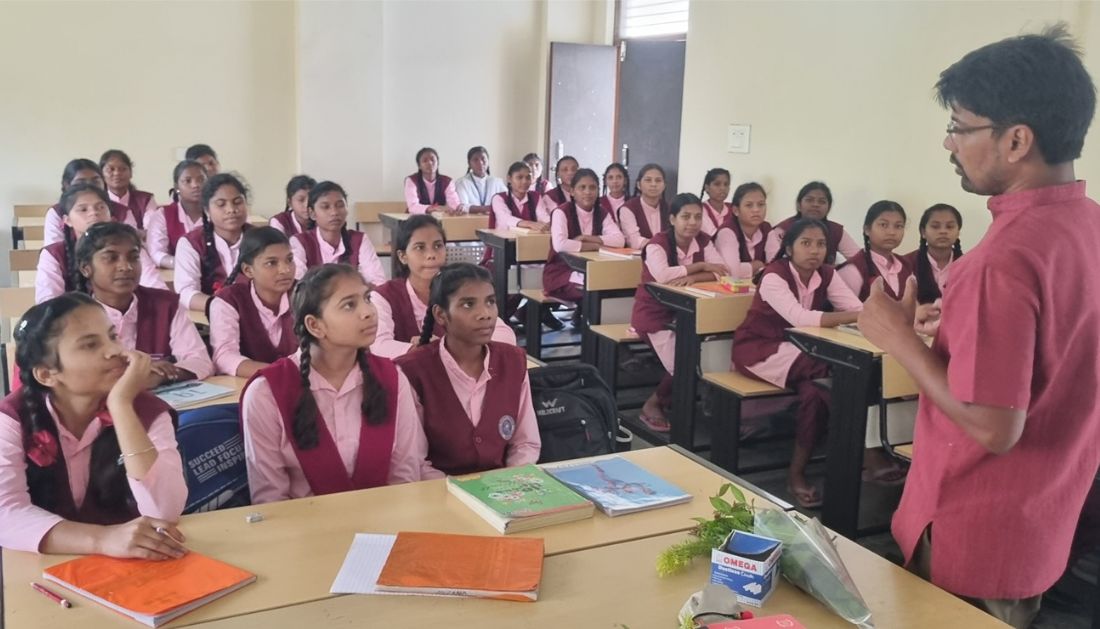
He works mainly with students finishing twelfth grade — the fragile bridge between childhood and choice. "It's the moment when everything can go either way," he says. Bharat Calling now conducts IQ and aptitude tests, maps interests, and helps students and parents make informed decisions.
The financial gap is often bridged by goodwill: alumni, teachers, and strangers who call after reading his posts. "A student once told me he'd lived twelve years believing he could never afford college," Sandeep recalls. "The next day, someone paid his entire fee. The hardest part isn't money. It's helping them believe they deserve it."
calibrating conscience
Success, as it often does, brought distortion. Funding poured in, expectations grew, and the work began to drift from its intent. "We had to scale, report numbers, raise grants," Sandeep says. "I became a human-resources manager instead of a teacher."
He launched a rural fellowship and sent volunteers into villages, but over time realised that the fellows were benefitting more than the children. "We were updating résumés, not transforming lives."
The decision to stop was difficult but deliberate. "Because we paused around the time Covid was raging, everyone assumed that was the reason," he says. "But it was conscience, really. We had to become small again to stay honest."
For six years, he withdrew, reexamined his motivations, and re-started quietly — working again with a few schools and a few dozen students, the way it had begun. "Now there's no pressure," he says. "No donors, no scale targets. Just work that feels true."
the circle returns
The second life of Bharat Calling looks different. Funding now comes not from institutions but from the students it once helped. "Sixty per cent of them contribute back," Sandeep says. "Some earn thirty, some fifty thousand rupees. I even borrow from them sometimes."
Among them is Kishan, one of Bharat Calling's early students from a small village near Hoshangabad. Kishan had once imagined a life in uniform — the army or the police — until a summer camp with Bharat Calling expanded his sense of what was possible. "I didn't even know English then," he recalls. "Sandeep bhaiya helped us see that there are other ways to serve — through development, through education.”
Kishan went on to study forestry and environmental science, followed by a master's in sustainable natural resources at TISS. For the past seven years, he has worked on agriculture and water programmes in rural Chhattisgarh and Madhya Pradesh. Today, he also supports Bharat Calling financially. "If one person from our area moves forward," he says, "it motivates many others. I contribute what I can because someone once did that for me."
For Sandeep, this reciprocity is more potent than any grant. "I never wanted to build an NGO," he says. "I wanted to build a circle — where people help each other when it's their turn."
Teachers see the difference. Bharadwaj Sir, a senior teacher at Government Kesla Higher Secondary School told Linchpin, "If people like Sandeep stop working, an entire community suffers. Children who once had nothing are now clearing national exams."
Kaushalya, now a music teacher in Kendriya Vidyalaya Visakhapatnam, still calls him Bhaiya. "Because of him, I sat in an AC compartment for the first time," she says. "He told me I could study music when I didn't even know it was a subject." She went on to complete her PhD and qualifies as one of Bharat Calling's quiet triumphs — proof that exposure can be destiny.
the inheritance of courage
Sandeep often thinks of his father when people call him selfless. "I'll never match his purity," he says. "Professional training takes some of that away." Yet, the echo is unmistakable. His father once stopped on a road to help a stranger get medical treatment; years later, that man wept as he told the story. "That's when I understood," Sandeep says softly, "that a life can be much bigger than a family."
He no longer measures success by numbers. "If the child is happy, that's enough," he says. "Why force them into a world they don't want?" The work now is relational — not persuasion but patience. "We don't let parents become villains," he adds. "We tell students, you make the decision. That keeps peace in the home and responsibility with the child."
When asked what advice he'd give his younger self, he pauses. “Don't give all twenty-four hours to anything," he says finally. "And don't undervalue yourself just because you don't have money yet."
As for others hoping to do similar work, his counsel is both simple and profound: start small, start nearby, and study. "Theory gives you clarity," he says. "It polishes you. Without it, passion alone burns out."
He dreams not of expansion but of endurance — a Bharat Calling that remains personal enough to remember every name, yet wide enough to remind every child that worth is not inherited.
"I don't know how to convert this passion into a framework," he says. "Maybe it isn't meant to fit one."
In that uncertainty lies his conviction.
Because for Sandeep Mehto, the journey from student to teacher has never been about creating an organisation. It has been about creating a conscience — and teaching others how to listen when it calls.