Our ambition was to sustainably grow, never to look at it as a numbers game.
The public focus on companies that are large or aspiring to be large makes it seem that bigger is always better, that a business must keep growing else it risks dying out altogether. But the truth is that such businesses i.e. those designed to be scaled, make up a small proportion of all the businesses around us. There are a large number of small, privately owned businesses that are successful, financially healthy, and growing at a steady pace – and there is great value in this.
In his book Small Giants: Companies that choose to be great instead of big, Bo Burlingham writes about this category of businesses. Businesses that have “chosen not to focus on revenue growth or geographical expansion, instead pursuing other goals that they considered more important than getting as big as possible, as fast as possible.”
Small giants, according to Burlingham, have goals, ambitions and priorities beyond just their financial ones. Of course, being profitable is important for the health of the business, but these businesses aren’t driven by the goal of growth for growth’s sake. They are “interested in being great at what they [do], creating a great place to work, providing great service to customers, having great relationships with their suppliers, making great contributions to the communities they [live] and [work] in, and finding great ways to lead their lives.”
And staying agile is critical to achieving these interests.
We spoke to Anand Hariharan, Co-founder and Chief Solutioning Officer at Indexnine Technologies, a design-led software product engineering company head-quartered in Pune – a company that chooses to remain agile so it can nurture the quality, creativity, and sense of ownership that is critical to successful product engineering in an industry which evolves continuously and faster than any other.
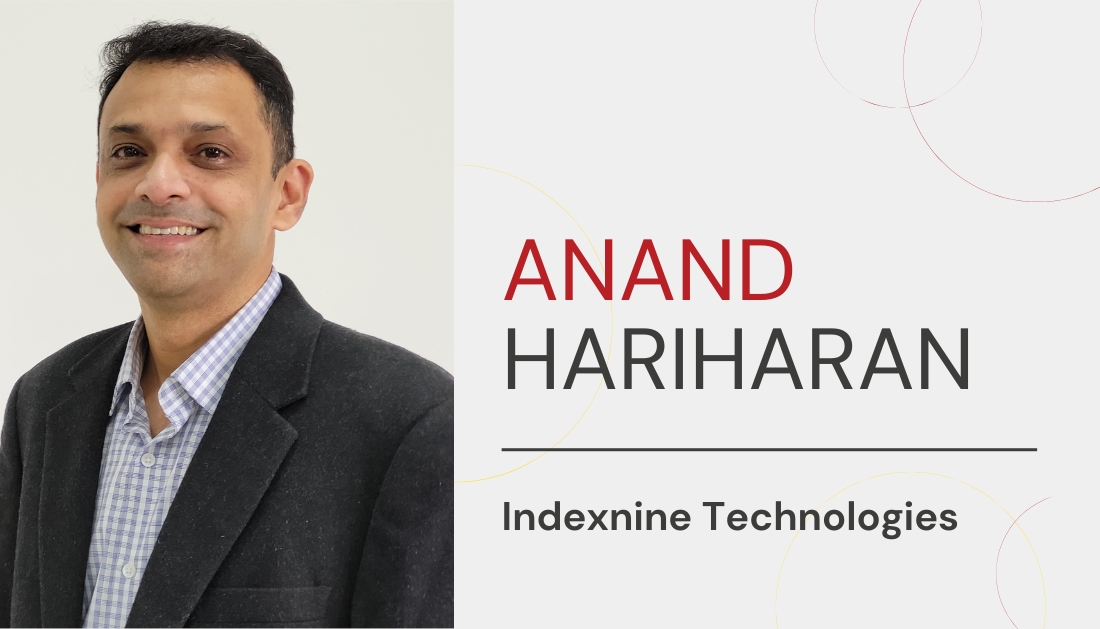
On becoming an entrepreneur
Anand, by his own admission, “was never good at academics”. But he considers that a stroke of luck, a blessing in disguise – it did, after all, lead him to his passion for technology. Barely scraping through in the rest of his academic subjects, he was drawn to computers from an early age. Writing code and building things gave him a feeling of competence and creative satisfaction that no other discipline did.
After gaining a Bachelor’s and a Master’s degree in Computer Science, Anand started out as a software engineer at Frontier Software Development, Pune in 1997. Over the years, he built an impressive set of product development and management skills through a career spread across Veritas Software, Symantec, and Clarice Technologies (now Globant). After an eight-year stint in the United States, when Anand returned to India, it was for personal reasons. But the opportunity to build something of his own was already at the back of his mind.
Inspired by people he had worked with, people whose work he admired, entrepreneurship simply felt like a natural progression for him in his career. A conversation with a friend (Shashank Parab, co-founder at Indexnine) at a tennis match was the beginning of what is now a nine-year-old thriving software product engineering business.
“I was in product engineering. I worked in large companies where there is a standard way of doing things and everybody is expected to follow that standard.” Anand tells us.
“For me, I wanted to do the work a particular way and that is not something a large organisation could support me with. So my motivation, you know, was hey, this can be done in a better way, right? There need to be better outcomes. How can we deliver better service? And that's where Indexnine was born. I wanted to see my ideas come to life.”
As an entrepreneur, Anand thrives on the freedom to chart his own course. For him, it is about two things: agility —the ability to make decisions and act quickly —and the quiet thrill of watching teams that he has built come together, flourish, and deliver.
At Indexnine, the numbers speak for themselves: over 90 products developed, averaging 10 a year. Many of these, he says with more than a hint of pride, were executed without his direct input. “It’s proof that people here take what they’ve learned and run with it. That’s incredibly rewarding.”
Then there’s the feedback: a satisfied client, a major win, a new account. Each moment is a reminder of why he does this. These are the things, he says, that truly float his boat.
On doing fulfilling work
For Anand, creative fulfilment has always trumped financial ambition. He is drawn to the challenge of doing things differently, and Indexnine’s portfolio — stacked with projects others might shy away from — reflects that philosophy.
“Most of our customers are startups,” he says.
It is about what smaller teams allow them to accomplish. A tightly knit team, where everyone knows each other and the client, fosters collaboration and agility. “A small team is just more agile,” Anand explains. “When you have a large team, decision-making slows down. You can’t pivot quickly, experiment, fail fast, and adapt. That’s harder to do at scale.”
Indexnine’s structure reflects this philosophy. “There are 20 teams of 10 people each,” he says. “You think of it as one organisation, but the work gets done by these smaller teams. In a way, there are multiple Indexnines within Indexnine.”
Having small teams means that there is a human dimension to every client interaction, with every team member having direct access to the client. Not only has this made communication efficient but it has also helped Indexnine deliver technically and creatively challenging projects.
“Our customers really love working with us. The testament to that is that throughout the nine years, we have grown purely through client referrals. Even today, the majority of our new leads come from customers who connect us to other customers. So it is an endorsement that we have done well.”
Nevertheless, staying small has thrown up its own set of challenges. “Early on, we would take anything that came our way. So if you look at our portfolio today, from a product building perspective, a software product building perspective, we can do anything under the sun. We are equipped to work in many different verticals. But that sort of makes us a jack of all trades. To cultivate people who are very deep in a particular area takes some kind of focus.”
A jack of all trades himself, Anand admits that Indexnine’s portfolio is a reflection of his own journey as a software developer who codes in nine different languages.
“Indexnine’s portfolio, like my own competencies, is spread wide across many areas. We have spread ourselves across so many things and not gone deep into one thing.”
Anand believes that this approach is the reason they are still small, especially in their endeavours to scale in a few verticals. “People don't always understand us as a company. And that hurts us because when I show somebody our showcase – say, there are 30 projects – everyone comes out of the meeting impressed: Oh, you did all of these things, that's awesome.”
“But they'll ask you, say, what do you do in data engineering? What is a specific thing you can do in this discipline? That is a bit difficult for us to explain. The answer cannot be: I do everything.”
Deeply aware that Indexnine’s initial messaging wasn’t focused, Anand and his team are changing that. “Now we have more mature people in the organisation and there is focus in specific sectors. We'll go deep in there, so our initial detour will get rectified.”
Regardless, being a jack of all trades has been creatively challenging and deeply rewarding, says Anand. In fact, it appears this regret at going wide isn’t a regret at all but simply a reflection of Indexnine’s values and priorities.
“There is value in going deep, and there is also value in going wide. So I wouldn't really say that there is something wrong with our journey so far; it’s just how our current situation is. We are spread across a lot of different things, but this brings deep joy and excitement to our work – we get to do something new every six months.”
Given the chance at a do-over, would Anand do it any other way? Not really. “Our ambition was to sustainably grow, never to look at it as a numbers game. Even today, if I get both the options – scale, scale, scale versus staying small and doing good, diverse work – I would pick the diversity mode. And that's just me. It'll be different for different people.”
The architects of small giants
In Small Giants, Burlingham outlines some of the characteristics that the founders or owners of small, purpose-driven businesses share with one another. Among them were questioning the usual definitions of success, building the kind of business they wanted to work in rather than giving in to external forces, and most importantly, passion.
Like these architects of small but successful and valuable businesses, Anand and all the other entrepreneurs featured in this edition are driven by an insistence to prioritise real value over scale. They imagine ways of doing things other than those we are all familiar with and bring great passion to their work to build companies that align with their visions.
These businesses may be small, but they are mighty.