I believe it is dhrid sankalp — purposeful determination. Sometimes the universe conspires to test your resolve.
On July 31, 1987, on a day so wet that recruiters had almost given up on anyone turning up, a young mechanical diploma holder walked into an interview room. Airtech, a company led by Sant Advani, was hiring sales engineers. They were desperate for someone willing to take the job. He had been rejected by the giants L&T, Ion Exchange, and Mukand Iron & Steel and was desperate for a job of any kind. He wasn't the first choice, but he was the only choice.
The deal was struck. Aasif Ahsan Khan, AK as he is called by everyone, including his children, started on a salary of ₹1,000 a month.
"I saw the recruitment flyer on my college notice board by chance, by accident," he recalls. "I was rejected everywhere, and Airtech needed a guy that day. I was the guy."
Sant Advani, he says, taught him so much more than how to sell. "He taught me about life. He showed me that respect and kindness cost nothing, but they can make everything." Within three years, Aasif was working with clients like Garware Plastics, Burroughs Wellcome, and Johnson & Johnson, discovering an industry with an infant's curious eyes. He had no pedigree, no godfather, and no plan. What he did have was an instinct for opportunity and the unbridled determination to push farther than anyone expected.
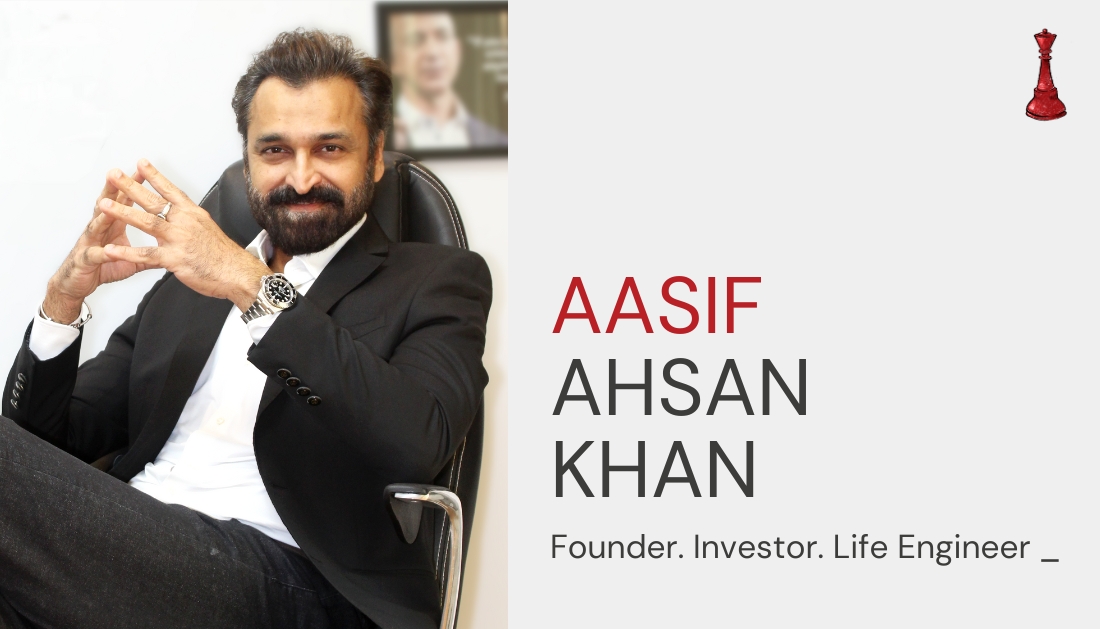
first steps, false starts
By his mid-20s, he had already branched out. With partners he met along the way, Aasif co-founded Airpac Filters to manufacture HEPA filters and laminar flow benches. It was a small enterprise that won an overseas contract before it made a mark in its home country.
This first project in Syria was valued at $287,000 — a staggering figure at the time. The scope of the project expanded, and the contract went up to $337,000. Then the rupee devalued. "You could call it a windfall," he says. "We made more than ₹40 lakhs, which was the start of the factory and everything we now have."
That project carried another story, one he has often retold. It still amazes him that Dr El Raie, the owner of Medico Labs, trusted him with it. "We were nobodies. There was no reason for him to choose us. His tech consultant was determined not to give us the project. But Dr El Raie walked up to me, broke a banana in half and gave it to me, saying, 'No one in my team wants a new company, but I feel I can trust you. Whatever you do, do it sincerely. Mabrouk!' For every project since, a silent, heartfelt prayer has been given to him; he was the thrust that sent our rocket into orbit."
That windfall was a catalyst, setting him on the road to manufacturing cleanroom equipment at scale and unlocking international markets. Soon after, with collaborator Hemant Anavkar, he co-founded Airpac Exports, a consultancy that sourced and shipped pharma equipment across the Middle East. Their nine months together on the Syria project forged a lifelong bond and reinforced Aasif's instinct for collaboration — a collaboration that eventually became Fabtech, the 26-year-old start-up — he shrugs off the word 'giant' — he started with Hemant. The early years were slow, but momentum compounded once the pivot became clear. Defining moments arrived in waves: breaking into international markets, delivering Oil-for-Food Programme projects for Iraq once thought out of reach, and standardising modular solutions to maximise impact. The north star, through it all, was to build a company that outlived its founders by professionalising, letting go when needed, and blending seasoned "old hats" with hungry professionals.
baptism by failure
Aasif is refreshingly transparent about the triggers, the stumbles, and the triumphs that have punctuated his journey. One of the most formative came at ACHEMA 2003, the global pharma trade show in Frankfurt.
By then, Fabtech, his flagship cleanroom panel manufacturing company which his younger brother Aarif has been instrumental in shaping, was already making waves in core markets. Convinced ACHEMA would catapult them into the big leagues, he decided to showcase a life-size cleanroom mock-up at the show. Fifteen people travelled from India to Germany to install it. Three days and nights later, it still wasn't finished. "It was a disaster," he remembers. "We had no clue what we were doing."
He talks about how Shyam Khante, the global manufacturing head of Dabur Pharma (now Fresenius Kabi), was at the show. "Dabur had just finalised a project with us. I was terrified that Mr Khante would see our disaster of a mock-up and cancel the project. So I did everything I could to distract him", he says with a laugh. They even shipped a full container load of catalogues. "We thought prospects would rain. We had to dispose of ninety per cent of it — even paid wastage charges."
The lesson was painful but permanent. "Global trade shows are global trade shows," he says, with a wry smile. "You can't wing it." It was not the last time he would fail. But Aasif's willingness as a leader to own every failure and learn from it is refreshing. "Look," he says, paraphrasing Wayne Gretzky, "You miss 100% of the shots you don't take. The shot may not go in. You may look ridiculous. But the only real failure is not to try."
He remembers ACHEMA with "gratitude for tuition paid." The fiasco taught discipline, rehearsal, and the humility to scale demonstrations to context. "I don't see it as humiliation," he says now. "It was feedback at an industrial scale." The takeaway travelled home: build a process that survives pride.
It also fashioned a leadership instinct: throw people into the deep end, but stand by to pull them out if needed. It became the house method: figure it out, then teach it forward.
madness, method, and PAW
Aasif says there was never a master plan. "There was no strategy. Still isn't. Just madness minus method, big determination and the belief that there is nothing we can't do. We should already be underground with the risks we have taken. Failure just wasn't an option."
But slowly, a pattern emerged. Aasif realised they had built, almost by accident, a capability matrix that became Fabtech's passport into global pharma. They called it PAW — process, air, and water — allowing them to qualify for projects across emerging economies.
Early expansions came from instinct, opportunity, and sheer audacity. Investments followed the same rhythm: TSA (later acquired by Thermax) for water, Pacifab for encapsulation, Mark Maker for granulation, among so many others.
From PAW's spine, the group branched into capability adjacencies — training (Pharmastate Academy), storytelling and industry signal (an early seed in Kable Digital Media, which also owns Linchpin Magazine).
the builder's creed
Internally, leadership hardened around a simple rubric, which Aasif, who has a decided quirk for acronyms, calls ABCDE: assess what truly needs strategy; build for fit, communicate, delegate — "mad delegation" with a watchful net so no one drowns, and drive efficiency by hiring people who don't need permission to do the right thing. Then "remove the fear of failure, and see them shine". He's tough on small, repeated mistakes, lenient on the big, brave ones.
"The only non-negotiable is removing fear; the rest can be taught. Pair the right person with the proper mandate, then get out of the way."
Aasif's uncanny ability to recognise and celebrate intellect and capability sets him apart as a leader. Free of the ego that so often defines the traditional CEO, he has built a culture that honours talent rather than competes with it.
"Good leadership is intrapreneurs taking ownership — people who streamline processes, harden systems, and make them unbreakable without constant escalation."
It says as much about his leadership as his single-minded resolve to build something that will outlast him.
from tailor's son to builder of industry
This resolve had roots long before Airtech or Airpac. Aasif, the oldest son of a tailor, grew up in a 80 sq ft room, the washroom outside, and rats nibbling his toes as he and his younger siblings slept in the verandah at night. He went to school in the morning and to the madrassa in the evening.
"But I used to talk a big talk. I used to tell my friends we had farms and horses and travelled by plane. We had nothing. But I had dreams bigger than my stomach."
On train rides, he would stare at Mumbai's tall buildings and promise himself he would own a home there one day. That audacity — part fantasy, part survival — became the heartline of his life.
"My father used to say, niyat mein barkat hai. There is an abundance in true intent. If your intent is clear, the path will open. You must walk it with courage."
the triggers
But even resolve stands on fuel. For Aasif, three moments lit fires that still burn.
The first came in Bangladesh in the early 1990s, where Airpac exhibited alongside industry heavyweight Klenzaids. Mr Lala, business custodian of Klenzaids, came to see the booth, looked around, nodded and left. A gesture of generosity between leader and new entrant, Aasif thought. Later, at the airport immigration queue, Aasif walked up to say hello. "He looked me up and down and just turned away. Everyone from the industry was watching. Those 20 steps back to my place in the queue were the longest I have ever taken. Bloody eternal."
The second came from Supersonic, a leading ultrasonic washer manufacturer. Aasif went to their Andheri office seeking collaboration. The owner dismissed him outright, mocking his youth, turnover, and even appearance.
The third came at the Indian Overseas Bank. His Syria project needed a ₹20-lakh loan to bridge working capital. With no collateral, Mr Chibber, the manager of Indian Overseas Bank, told him bluntly, "You don't have a pushcart of your own, and you're dreaming of helicopters."
Each rejection cut deep. Each became fuel. "This isn't mere audacity. I believe it is dhrid
sankalp (purposeful determination). Sometimes the universe conspires to test your resolve." For Aasif, "every humiliation, every 'no', and door slammed in your face is not the end, but a signal to dream bigger and persist harder."
He frames these moments without rancour: "They were calibrations, not condemnations." Each refined his stance: resolve over resentment and a return to first principles — "dhrid sankalp guided by niyat."
the case for collaboration
Perhaps because rejection and humiliation marked his early years, Aasif grew into an entrepreneur who instinctively chose collaboration over competition.
It’s why he consistently backs talent that is too small for private equity but too ambitious to be ignored.
"When we were young, we had to appear older just to be taken seriously," he says. "Today, I see young people starting up, and I want to give them respect. If I treat them the way I was treated, they'll end up against me one day. Instead, why not invest in them and enable them?"
Collaboration, in practice, means adjusting the centre of gravity. He cites a conversation with Kelvin in which a single sentence changed how a partner thought about ownership: "Make business your convertible currency; don't become its slave." Build a company beyond you; let the collaborative front run independently while you hold a steadying role. The result is speed without panic, and resilience without ego.
"I want the ecosystem I'm building to be considered for every project, machine, spare part, change part — anything in the ecosystem. Not to win every deal, but to have a seat at every table."
against old school stagnation
Not everyone agrees with Aasif's collaborative ethos. The fiercest resistance comes from some of India's old-school, family-run businesses. Their constraints, he argues, are structural.
"A handful of generational businesses are thriving in our sector. There are two stumbling blocks. The father who built the business, and the chartered accountant. If they are friends, it's a nightmare. The father says, 'I built this, don't mess it up.' The CA says: 'Don't sell, don't risk.' And the next generation loses the freedom to fail."
For Aasif, that loss of freedom is fatal. "Valuation is not just numbers. It is what difference you can make to the industry and how you can improve the world. Professionalisation is the single most critical thing. The more the Indian biopharma engineering industry remains family-run, the more it will go south."
His critique isn't a takedown; it's an invitation to grow. Professionalise the books, separate valuation from audit, and let the next generation earn their failures. Where openness has met capital, he's watched traditional firms stabilise, scale, and surprise.
a vision for biopharma
Aasif calls himself a Life Engineer — a reminder that his work touches life-saving drugs and access in places the world forgets. He says preparedness begins upstream — with forecast, anticipation, and deployment at the edge of detection. The pandemic was a teacher here: The pandemic proved that modular, locally deployable capacity is not a nice-to-have but national infrastructure. "If you're starting when the problem is visible, you're already late."
He is relentless in his push for a stronger, more unified Indian biopharma engineering sector. "We have made India the pharmacy of the world," he argues. "But after that, it is European machinery that caters to high capacities. Unless we shed fragmentation and pool our strengths, we remain small players in a big game." For him, it is not just about survival but about ensuring the Indian industry's place in the future.
He is vocal within the Indian Pharmaceutical Machinery Manufacturers' Association, often criticising its exhibition-only focus. "Fight for subsidies and PLIs," he urges. "Encourage R&D. There is talent available. What we lack is capital and courage."
The comparison with China is pointed: "The Chinese government removed the fear of failure. We have no such support. We must consolidate, collaborate to create value, and be taken seriously."
what makes a venture investable?
Investment potential, for Aasif, is less about a moment and more about listening in 360°. The order of listening matters: first to the founder, then the team, then what the industry says, and finally what clients say. Praise that arrives in your absence is the truest signal.
Numbers are noted, never worshipped. And sometimes, despite every headwind, gut feel tips the scale. He has backed ventures when they were headed south, even when legal cases made them unbankable on paper. "If the founder's integrity and intent are intact, the story can still turn. Sincerity to the mission despite failures is the real diligence."
Aasif is tenaciously vocal about removing the stigma of failure: "We need a forgiving ecosystem. One that doesn't punish entrepreneurs for stumbling, but frees them to try again. Each failure carries the seed of a future breakthrough."
ecosystems not empires
From starting life in an 80 sq ft room to a founder of factories and funder of futures, Aasif's journey has been improbable and audacious. He walked in with nothing — no godfather, no pedigree, no privilege — and built something enduring, "a collaborative ecosystem where everyone wins."